Capture and coast
Have a look at two versions of the same post, one on Substack and one on LessWrong.
With even a cursory glance, it seems clear that the LessWrong interface is much better than Substack’s. Footnotes appear inline as Tufte-style sidenotes, meaning they can be seen alongside their context without having to scroll to the end of the page. (In a print book, having footnotes at the end of the page or endnotes at the end of the chapter makes sense – they’re a space-constrained medium – but on the web there’s no reason for this.)
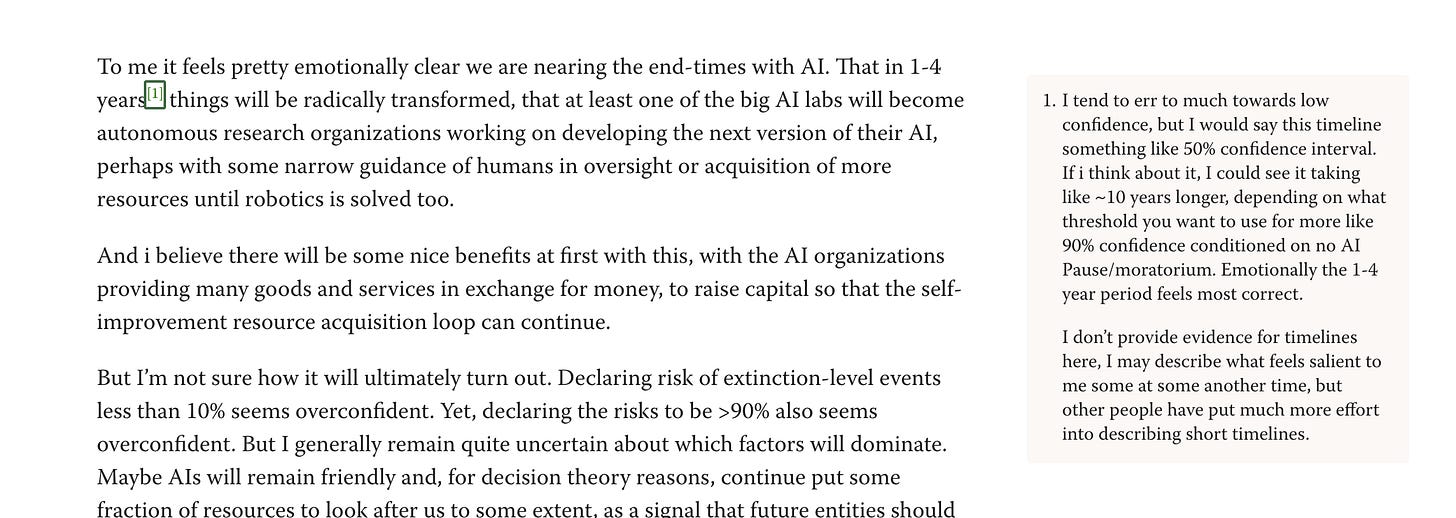
Comments on LessWrong are much, much better than on Substack. (The whitepill here is that it’s possible for a small, mission-driven team to produce better software than a billion-dollar business.) WordPress has had nested comments since 2009 and Substack’s implementation is still worse somehow.
There’s very little visual hierarchy, making the boundaries between comments hard to scan. Comments are strictly plain text, with no ability to format them or tag other commenters. Until recently you had to click through from an article page to see the comments section, and to view comments nested more than one layer deep you need to click through again. [EDIT: you actually still need to do this, but not on Astral Codex Ten, weirdly, which makes me think there’s some special mode for larger Substacks.] You can ‘like’ comments but you can’t give other reactions, you can’t downvote, you can’t tag other people, you can only sort by date, collapsing threads is done by clicking in an unintuitive place.
It’s dogshit.
(Substack has a bunch of other ridiculous limitations, like no support for tables.)
Platform ossification
Why am I bitching about comments so much? Because this sort of feature downgrade is endemic anywhere there’s platform lock-in. The product simply doesn’t need to be as good – the network is the product, and if you can’t get eyeballs on your blog unless it’s on Substack then Substack doesn’t need to have anything like feature parity with other platforms.
Platforms innovate, then once they have the network, they stop improving.
The same is true of the social media platform formerly known as Twitter. At its inception it was something genuinely new; at-handles, hashtags and retweets were all genuinely innovative. Then they spent a decade copying other platforms’ features (mostly badly), and latterly Musk fired 80% of the engineering staff, which left the platform functional but ossified. Longstanding bugs never get fixed. The network lock-in is now so strong there’s no reason to – it’s the internet’s de facto public space. Good luck getting your shitty Mastodon “toots” to have even a hundredth of the reach of your tweets.
A number of other examples of this kind of ossification/enshittification come to mind:
Slack search is still horribly broken
Reddit is actively hostile to its users – lots of gating that requires you either to sign in or download the mobile app, plus they killed popular third-party apps like Apollo overnight)
Google Maps’ UI seems to get progressively worse and harder to use with every passing year
Instagram fought chronological feeds for years after switching to an algorithmic feed (there was even a #RIPInstagram campaign to get them to switch back)
But platforms do add new features!
There is some amount of innovation going on – usually driven by a competitor implementing a new feature (think Stories being added literally everywhere, or Twitter Spaces as a response to Clubhouse). Instagram Reels and YouTube Shorts were a response to TikTok’s ascendency. (Maybe this post should have been called “the enTikTokification of everything”.)
And those features are horrible! I hate reels! I have to install a panoply of Chrome plugins to block Shorts! We ended up inventing a word to describe becoming horribly addicted to these things and collectively wasting billions of hours a day on them!

This is a different pathology from ossification, but it too comes from network lock-in. Shoving unwanted short-form slop into an app for sharing photos with your friends would be suicide for any company which didn’t have a total stranglehold over their audience.
When you scroll to the end of a Substack comments section, you just see a sad ‘Load More’ button. Infinite scroll never reached this part of the web, I guess.
1 comment
I completely agree. I've always found myself frustrated by the comments formatting on Substack, especially on mobile. But Substack does seem to be where the action is these days, especially for the people getting paid. Unless it all shifts over to Wordpress.com... XD
Reply on Substack →