Connection, loud and quiet
It seems intuitive that you feel more connected when you’re talking to someone than when you’re just sitting quietly with them.
But you’ve probably had a moment where you felt close to someone without needing to talk much. Maybe you were cooking together, co-working in the same room, or quietly solving a puzzle together. And you’ve probably also been in conversations where you just didn’t feel connected - too much small talk, or a conversation that felt a bit distant, or where your partner seemed elsewhere.
So is it true that conversation makes you feel more connected with someone, on average, than sitting quietly with them?
We ran two studies on the Inkhaven 2 cohort to find out.
(Our hypothesis was that extraverted people would generally feel less connected in these more ‘non-verbal’ scenarios. We found some interesting and weird results, but we’re saving them for the next post.)
Study 1 – Chatty Cathy
We built a Telegram bot that pinged people randomly throughout the day to test how connected they felt when they were with other people, and how this varied by what they were doing.
We asked participants to message our bot, Chatty Cathy. When being onboarded, they completed two personality tests, and told us when they woke up and went to bed. The specific personality inventories we ran were the BFI-2 Extraversion subscale, a short-form extraversion test, and BFI-2-XS, a short Big 5 personality test.11. Personality was measured using a blended Big 5 questionnaire: the BFI-2-S 6-item Extraversion subscale (two items each for sociability, assertiveness, and energy Level) plus the BFI-2-XS 3-item scales for the remaining four domains (agreeableness, conscientiousness, neuroticism and openness). The three ‘distraction’ questions we added were interspersed. We’ve only used the extraversion scores in this analysis. We also threw in a couple of unrelated questions so people wouldn’t know precisely what the study was about up front.22. Thanks to Aella for this suggestion.
Cathy would then ping them throughout the day to ask what they were doing and if they were with other people, and how connected they felt. We enrolled eight people, surveying each over at least three days (people could choose to participate longer).
So put simply, we asked: are you with others? What are you doing? And how connected do you feel?
We captured 40 pings where participants reported being with other people. We split these into ‘verbal’ activities – for example, talking to someone one-on-one or to a group – and ‘non-verbal’ – such as sitting quietly with someone. We then looked for a correlation between how connected they felt and the kind of interaction they had.
(A couple of ‘Other’ activities came in – “hanging out?”, and “berry tasting”, referring to another Inkhavener’s very fun miracle berry tasting session. We considered both of these as verbal.)
We found that people felt about 0.8 points more connected (on a 1 to 7 scale) during verbal interactions compared to non-verbal ones (p=.008, SE=0.31).
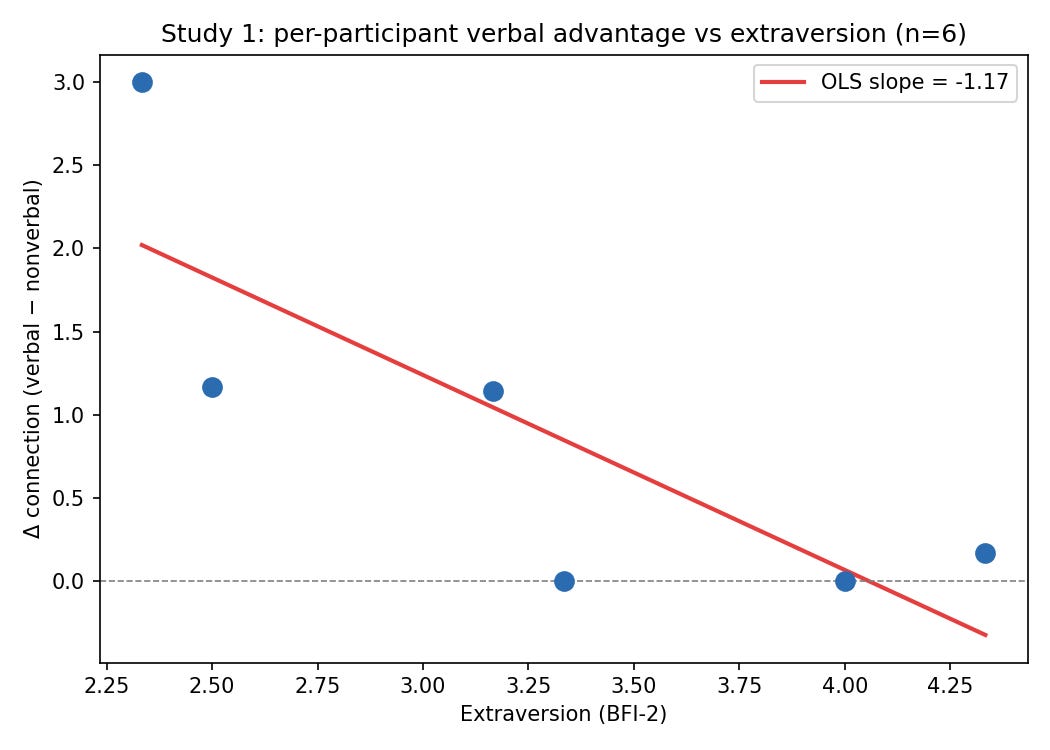
This is a small but significant directional difference, and confirms one hypothesis: that people generally feel more connected when they’re talking to someone than when they’re just hanging out quietly. None of the participants in the study had a ‘negative’ delta, so no-one felt less connected in the verbal condition and non-verbal.
Given our pilot study had only six participants, this isn’t enough to draw broader conclusions from, but it directionally points to people finding conversation more ‘connecting’ than just quietly hanging out, whether they’re extraverted or introverted.
Study 2 – puzzle or perish
We then recruited 16 volunteers, put people into pairs, and asked them to do two short exercises. In one, they were told to spend ten minutes talking to their partner about whatever they liked (we gave them a prompt suggesting they could talk about something interesting they’d read or seen recently). In the other, we asked them to work together quietly to solve a puzzle.
We took over two rooms on the Lighthaven campus to run these sessions. We onboarded participants with a personality test33. For this study we took the Mini-IPIP personality questionnaire (a “tiny yet effective” Big 5 questionnaire) and asked only the four questions on extraversion). We scored them 1-7 to match the scale in the Study 1 questionnaires., and then put them into a room to start the first exercise.
Each pair did the exercises in a random order, since we expected that the order (talking first or puzzle first) would affect people’s feelings of connection. At the end of each exercise, we asked a series of questions aimed at seeing how connected they felt. This let us compare the difference between the two activities within the same person, and see if that was linked to how extraverted they were.
Conversation made people feel more connected by 0.29 points (on a 1 to 7 scale), but the result wasn’t significant (p=.197). We consider this a null result – people don’t find conversation meaningfully more connecting than solving a puzzle quietly.
There are a few possibilities as to what’s happening here.
One is that working together on a structured task is just a good way to connect with someone. That might be doing a puzzle, cooking a meal together, assembling an IKEA bed, or anything with a shared goal.
(We should note that one extravert-extravert pair still talked a whole lot during the puzzle, despite being given the same instructions as everyone else – which maybe suggests that some people really do need a base level of conversation to feel connected, and they’ll seek this out even when there’s a shared task to do.)
It’s possible that ten minutes isn’t really enough time to have a meaningful conversation with someone that gets you into the ‘connected’ space, or at least no more so than doing a puzzle with someone. The pings in study 1 might have caught longer, more natural interactions.
Pairing people up meant that people didn’t choose to hang out with the person they were paired with. It’s quite possible that a short conversation with someone you don’t know well doesn’t build a connection as well as conversing with someone you’ve chosen to speak to in an open setting.
In short, we found that shared structured tasks get you closer to ‘conversation’ levels of connection than we had anticipated. There’s a gap, but much smaller than the prediction that talking beats silent company would predict.
In part 2, we’ll talk about how looking at the trends for introverts and extroverts specifically got really weird.
2 comments
Unfortunately we failed to abide by the directions to not chat while doing the puzzle but in my defense puzzles are boring
The real study is the puzzles we did along the way
Reply on Substack →