Frantically using Fable
Some suggestions for rinsing that token budget

Fable was released from its government-imposed shackles a couple of days ago.11. For those not deeply online: Fable is Anthropic’s most powerful AI model, a safer version of Mythos, which is being used to find oodles of exploits in the software which runs the world. The US Government took a dislike to it after a series of unfortunate misunderstandings and put the kibosh on it – which led to a lot of glee, given that Anthropic have themselves said that frontier labs need more oversight, but, what, not that kind of oversight? Well actually yes, not the kind of oversight where a capricious state decides to just randomly do stuff with totally opaque processes. I digress.
If you have a Claude Max plan (and I recommend you get one!) you have a couple more days of Fable access included in your plan before it becomes usage-based only, when you’ll have to pay for your usage at the normal rate, which is punishingly expensive.
For most that will just mean not using Fable, at least not until the price comes down substantially. This probably won’t happen any time soon – Opus, the next-best model, is still very expensive to use when paying the full rate.
So make hay while the sun shines, and make some things using Fable. A few things I’ve done:
🔍 Use the /improve skill to do wide-ranging audits on your codebases. I forked this from another author online to get it to present its as a nice HTML document to read through, and write up the top ten most pressing improvements as text plans for you to implement.
Bonus: get Fable to dispatch subagents to implement all of those changes in separate worktrees.
Also fun: on personal projects, use it just for UX improvements. LLMs are broadly less good at this, but increasingly they have taste and Fable especially so. Can be good for highlighting blind spots you might have developed from staring at your vibe coded projects for too long.
🪞If you keep a digital journal: ask Fable to give you a psychodynamic review, producing an HTML document with its analysis. I pointed it at my Obsidian vault which has a few years of journaling.
This one is sort of an infohazard – journals are very personal and initially Fable took a very adversarial approach, highlighting all the inconsistencies in things I’d said at different times, pointing out my various flaws and foibles, even digging into other documents (like blogposts I’d written, documents I’d highlighted etc). So be very careful what you ask for.
Necessarily your journals are not a complete accounting of your life. You probably write in them more when things are bad than when things are good, or when life is a bit empty rather than when it’s wonderfully full. So of course they give skewed impression of you.
I wrote a kinder version of this up as an agent skill.
🥂 Alternative to the above: get Fable to write your hagiography. Or at least something like a “therapist on a good day gives you a review”, which was pretty fun. I also wrote this up as an agent skill.
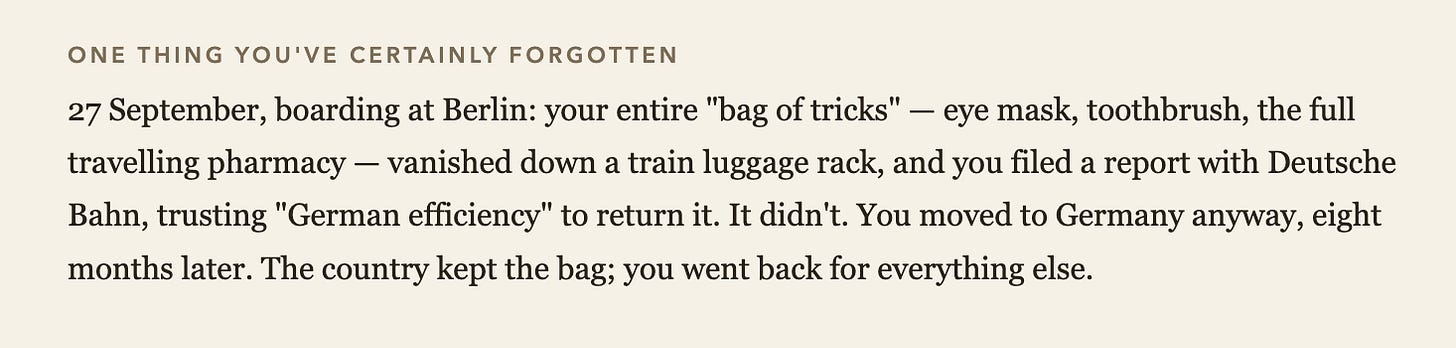
It turns out that if you have calendar entries dating back several years, you can ask the agent to review these year-by-year as well – and this not only gives the retrospective a bit more grounding, it also can highlight some really interesting patterns in your history.
Looking back helps you connect up the dots, too. Cutely enough, Fable included events and quotes from my journal which turned out to be deeply significant or foreshadowing, even if I couldn’t have known it at the time. Gives it a real sense of life being a narrative rather than just a series of things that happened.
Related skills
…so you can do these quickly. Use those tokens!