PSA: you should care about UV levels
They can be higher than you think!
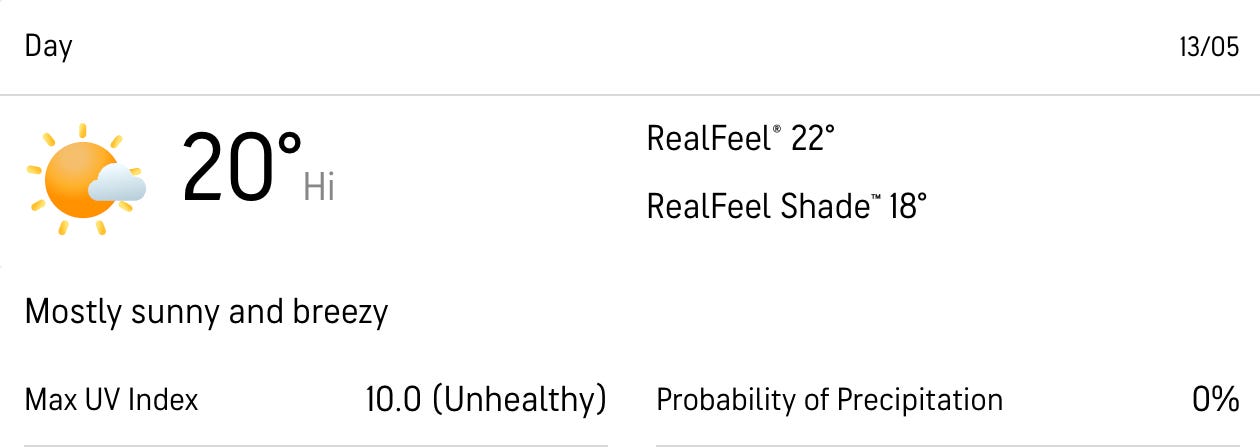
I’m in Berkeley, California. It’s mid-May, with highs of 20ºC (68ºF for those of you using old money). And yet the peak UV index is 10! It’s not even that hot!
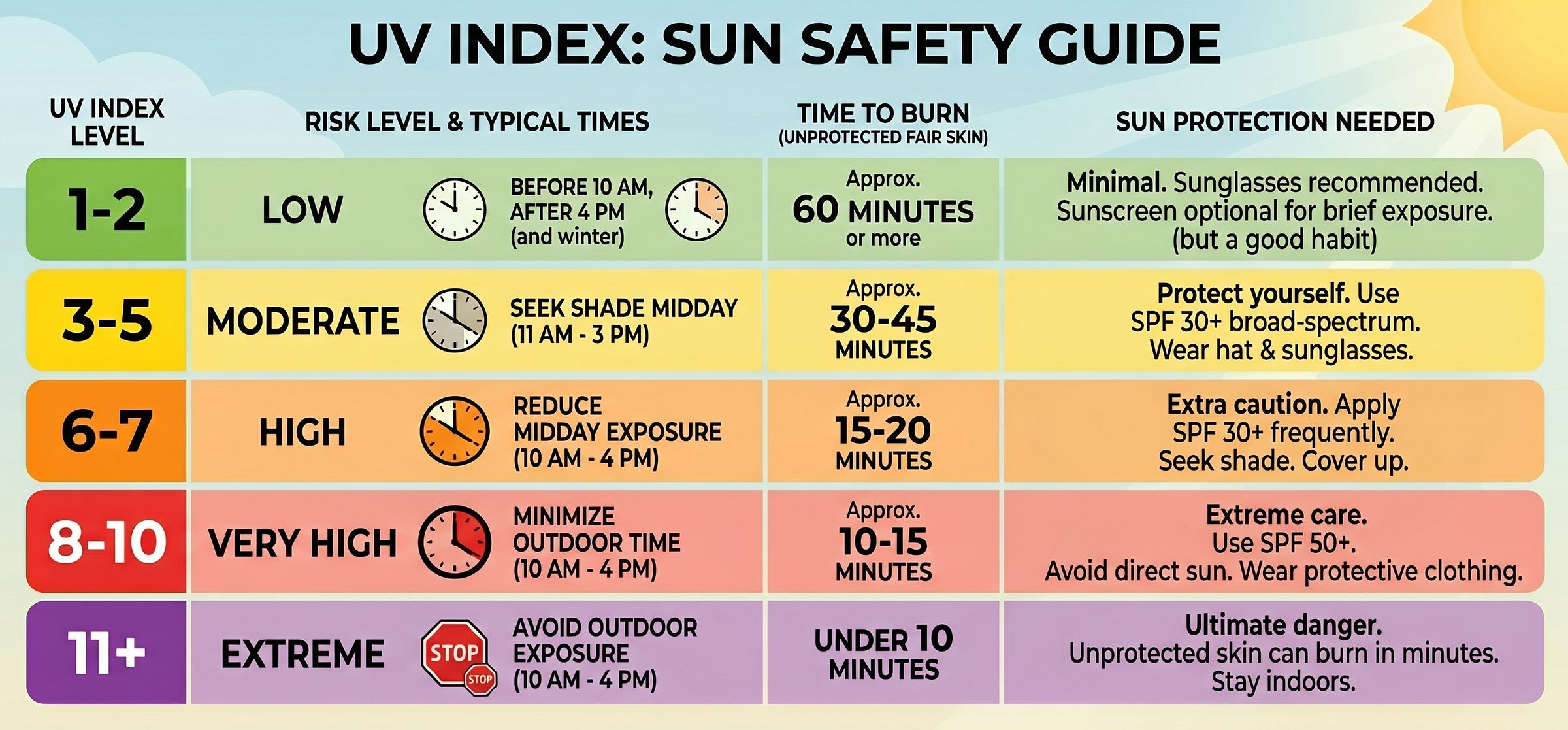
With this level of UV, people who are relatively fair-skinned burn in less than 15 minutes. Which explains the sunburn on my shoulders when I was wearing a tank top in the morning for about half an hour outside.
The UV index indicates the risk of burning for someone with lightly tanned skin, and runs from 0 to 11 (it’s open-ended; the Andes might see 20).
Intuitively we expect that the UV index is correlated with the temperature. This is a useful heuristic but for many places it won’t apply – skiers know that you can get cooked on top of the mountain, both from direct UV exposure and reflected UV from the snow (albedo). The same for coastal locations, where the sea air coming in off the coast has a cooling effect.
So for it to regularly be 10 in a place that isn’t actually all that hot isn’t that surprising, even if it feels like it ought to be. You sit outside and it’s sunny but doesn’t feel particularly hot, and before you know it you’ve been completely fried.
In some places there’s a long lag between peak UV and peak temperature. At 4pm in Britain it can feel pretty hot – the sun has had all day to warm the air – but the UV might be a third of what it was at its peak. But the mid-morning to early afternoon, when the air hasn’t had much time to heat up, feels much less threatening – which is where peak burning occurs.
There are other ways you can be exposed to UV without getting hot. Sunbeds are one obvious one; Iceland saw a sharp increase in melanoma which is attributed largely to indoor tanning. The side windows in cars and aeroplane cockpits block UVB but transmit a lot of UVA, hence the finding that pilots have twice the melanoma risk of the general population. (Laminated glass, like in car/cockpilot windshields, blocks both UVA and UVB.)
Some places expose you to more UV than just their latitude would suggest. New Zealand, for example, gets 40% more UV radiation than countries of the same latitude in the Northern hemisphere. This is due to a combination of the sun being closer during the Southern hemisphere summer, much clearer skies, and reduced UV-shielding from the ozone layer. As a result it has some of the highest rates of skin cancer in the world.
Places that are very high up are also much more dangerous – an extra 10–12% UV radiation per 1,000m elevation. Mexico City is at 2,240m so on an hot day you’ll burn much more quickly.
Worth also noting that some drugs make you more photosensitive. Doxycycline, frequently prescribed for acne, is one. Thiazide diuretics, a common type of blood pressure medication, are photosensitising too and have a documented risk of increased skin cancer.
Most people will want to use topical retinoids at some point. The evidence for them improving skin appearance and reducing wrinkles and photoaging is very robust, with research spanning several decades. They can make you slightly more photosensitive, so you should be combining it with sunscreen anyway – and being even more fastidious if you’re in a place with lots of UV.
So, citizens of sunny (but cool) places – wear sunscreen!11. Actually you should probably just wear sunscreen daily anyway. But especially if you’re getting nuked by UV all the time.
2 comments
OTOH, be sure to keep your Vitamin D level up (however you choose).
Phew scary stuff - I must definitely be cooked through by now
Reply on Substack →