The connection puzzle

Extraverts like talking with people more than introverts, but do they feel more connected during conversations than during nonverbal social activities, like co-working or doing a quiet activity together? This is the question we set out to answer.
Our hypothesis was that extroverts would feel more connected than introverts during social activities that involved talking, and that introverts would feel more connected than extroverts during nonverbal social activities. We also asked Aella for input on the study design, and she shared her hypothesis that extroverts would feel more connected than introverts across both conditions.
All of us were wrong! Across both studies, and across all conditions, introverts reported stronger feelings of connectedness in social activities than extroverts.
Whaaaaat
Maybe this was noise? Or something wonky with the statistics, since both studies were so small?
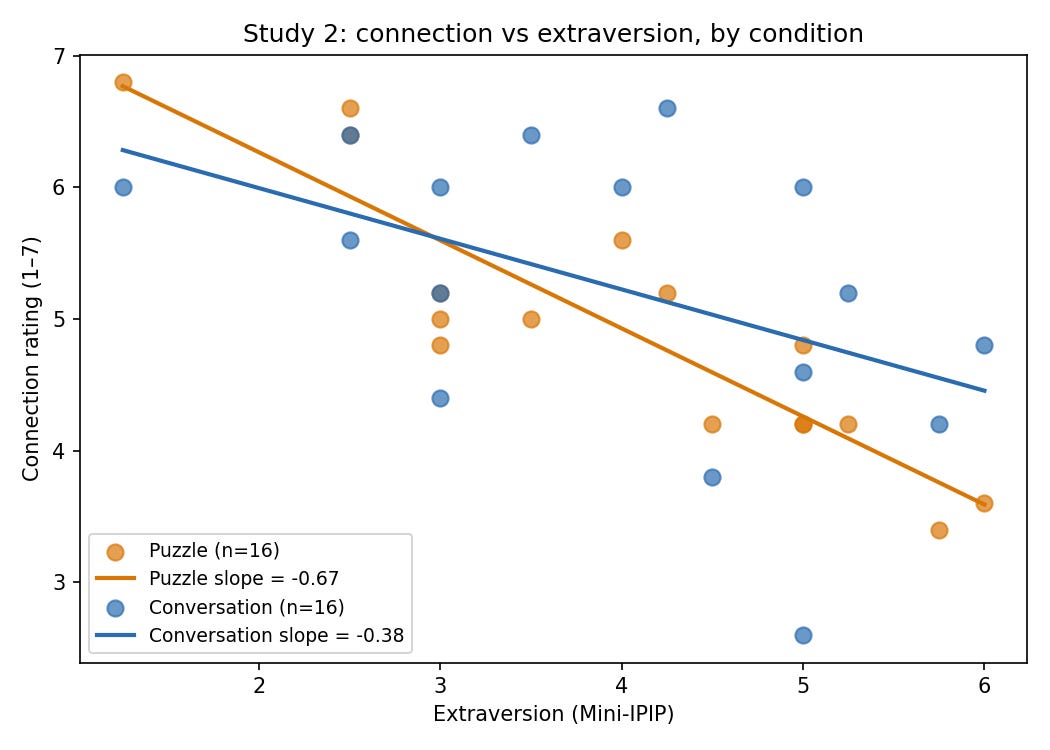
Nope and nope. Not noise – the gap in the second study was 1.5 points on a 7 point scale, so a robust difference! And not an outlier effect – this gap was consistent for every participant in both studies. So what’s going on here? Are we actually measuring what we think we’re measuring?
Introverts get a big boost from verbal interaction
The only significant finding in both studies was that introverts found all kinds of social interactions more connective than extroverts. But to understand what this actually means we need to look at how the rest of the results from each study differ. Unfortunately those results are a bit of a puzzle.
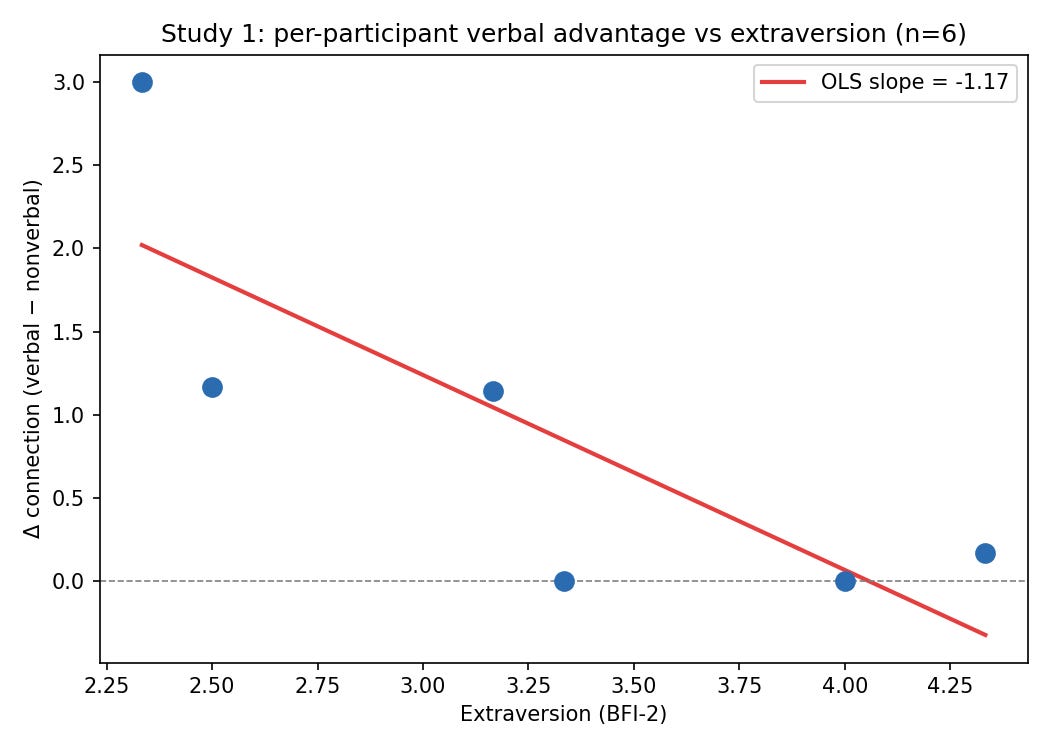
In study 1, we pinged participants several times during the day to ask them how connected they felt during different activities. We found that both introverts and extroverts felt more connected during verbal interactions, but that the difference was larger for introverts than for extroverts (p=.054, six participants on the plot). Contrary to our hypothesis, introverts get a bigger boost in feelings of connection from talking than from hanging out quietly with other people, as you can see from the downwards slope.
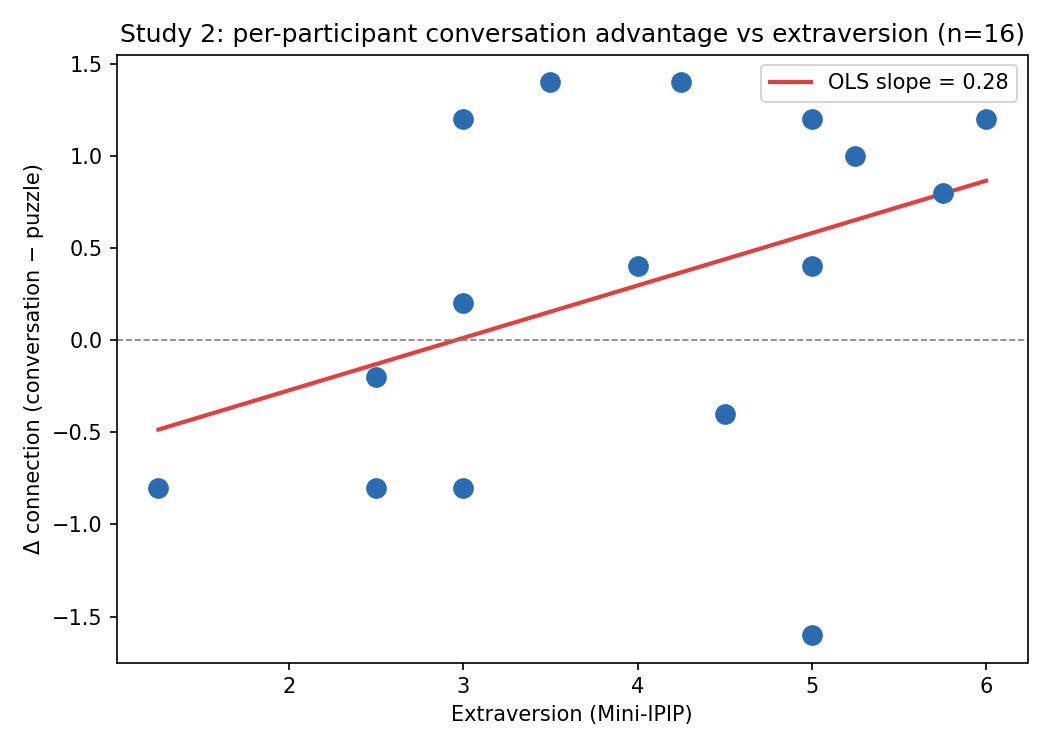
In study 2, we paired participants up and asked them to complete two ten-minute exercises, one where they had a conversation with their partner, and one where they quietly completed a puzzle together. We found essentially the opposite effect from study 1. Extroverts reported feeling more connected after the conversation than after the puzzle as one might expect, whereas introverts reported much less difference in feelings of connection (although the results didn’t reach significance at p=.096).
But oddly, introverts gave overall higher connection ratings than extroverts, and this was consistent across all our participants, as the downward slope in the below graph shows. We discuss this further below.
Given that the findings from these two studies (which were ostensibly asking the same question) point in opposite directions, we’ll have to look more closely at how each attempted to test the hypothesis, and the elements of the question they missed, to see if we can tease apart what we’re actually measuring.
Our thoughts
When we were forming our hypothesis we found research that said “extroverts like talking more than introverts. They talk faster, they say more words, and it makes them happy.”
Based on that, we were like hmmm… we know extroverts and introverts both like connecting, but extroverts seem to like conversation more, which is a common way of experiencing social connection. Maybe introverts prefer to connect in other ways?
But there are a few assumptions baked into that question:
We learned that extroverts liked talking more than introverts and we assumed that liking it more came from stronger feelings of connection.
We also assumed that for an extrovert any kind of conversation would be more connective than for an introvert.
These assumptions highlight just how nuanced this question is, and how hard it is to design a study that can accurately target and measure a social interaction without the results getting lost in noise. Here are a few ideas about what these studies were actually measuring.
People’s experiences differed from their expectations. It was pretty hard to get more than a few people to volunteer for either study, even with repeated posts on the Inkhaven Slack and lunchtime announcements. This was especially true for introverts, as you might imagine. The majority of our sample agreed to join after we specifically reached out and asked them to participate. (We understand that this is not random sampling, nothing about this population is random or will generalize, so let’s get that out of the way right now!)
We tried to keep it vague when describing what people would have to do for study 2, but we did say it would involve socializing. We suspect the combination of vagueness and socializingness made introverts feel some anxiety before arriving, but then actually chatting 1:1 with someone for 10 minutes was more fun than the introverts expected. On the other hand, extroverts might have been expecting something more lively or stimulating, and rated the experience less connective because of their expectations.
But this theory doesn’t fit well with both surveys. In study 1 introverts were reporting on whatever experiences they were having in the moment, rather than reporting on an experience they’d been anticipating. So if introverts are reporting feeling highly connected compared to their expectations, we should see that effect much more in study 2 than study 1. But the results in study 2 showed that introverts showed less of a change in feelings of connection after conversation than extroverts did, which conflicts with this theory.
Extroverts are connoisseurs of connective conversation. When introverts and extroverts score their experiences of connection they might calibrate the scale according to different “peaks” of interpersonal connection. If you think of extraverts as the wine snobs of connection and conversation, they may reserve 6s and 7s on the scale for highly stimulating and perhaps rarer experiences of connection. Introverts may have less overall experience to compare to and tend to be more liberal with using the top of the scale.
This may be true, but it’s true for anyone trying to score any kind of subjective experience on a scale. It also doesn’t explain why the two studies point in different directions. Plus, it’s a stretch to say that extroverts have higher peaks of connection to calibrate to, since introversion and extroversion have nothing to do with the capacity to feel connected.
Everyone is busy writing. We could only use data from 6 of the 8 participants who joined study 1 because we needed each participant to report their feelings of connection during a verbal and a non-verbal social activity at least once. Some people missed a lot of pings, but also, some people just weren’t very social over the course of the three days (perhaps because they were trying to get a lot of writing done). So it’s possible that the results from Study 1 represent introverts getting an unusual amount of connection from social interactions because they were in a period of relatively social isolation.
Perhaps people just feel more connected when talking with friends. In study 2 we didn’t prevent people from getting paired up with someone they knew, but we should have done this. People who know and like each other will obviously report higher feelings of connection than people who are strangers. Everyone knew each other to some degree, but in some dyads people were friends already and in others they’d never talked. The best conditions would be to have everyone paired with a complete stranger, but that wasn’t possible since everyone at Inkhaven has a relatively different degree of closeness/familiarity with everyone else. Having people paired up with someone they had never talked to before would have been an improvement.
Other dyad effects from study 2. With such a small study it’s hard to ignore all the dynamics that could be represented in people’s ratings of connection. Some pairs liked each other and some pairs didn’t, which influenced their scores. People may have felt more connected after the puzzle activity if they had already started with a conversation, an effect which would have been easier to control for with a larger sample size. We didn’t randomize the mix of dyads according to introversion or extroversion to start, so it’s possible every introvert got paired with an extrovert, and that made the conversations more fun for everyone. Maybe with a bigger sample we would have seen introverts reporting lower connection scores.
1:1 conversation and quiet activity are both ideal introverted activities. We designed the two activities to represent two different modes of socializing – a verbal condition and a nonverbal condition. We thought these might be indicative of two different types of socializing that appeal more to extroverts or introverts, but if you think of extroverts as wanting “high stimulation” and introverts as wanting “low stimulation,” these are both just the kind of socializing that introverts like more, which was perhaps why introverts didn’t feel significantly more connected after talking than after puzzling. The increase in feelings of connection for extroverts might have come from the increase in stimulation
Can we get anything from this?
The many limitations and confounders in each study makes it hard to be confident that people’s reported feelings of connectedness had anything to do with their introverted or extroverted tendencies, and that is borne out by the opposing findings of the two studies. However, we can look at the evidence from study 1 that verbal interactions do have an effect on feelings of connectedness, and the evidence from study 2 that extroverts specifically felt more connected after conversations. Taken together these findings suggest that the scale itself seems to behave differently for introverts and extroverts, perhaps due to the impact of participant expectations, though the direction of the effect was inconsistent.
What we could do next time
In a future, larger study, we would gather a larger sample of people who didn’t know each other at all. We would want to use the same extraversion instrument in both studies, and make sure we had enough data from each time-sampling study participant to be able to generalize more from the reports. We might also want to model partner-extraversion as a covariate in study. Finally, we’d test out the expectation-anchoring theory directly by asking participants beforehand what they expect from the interaction and see if the connection ratings are better predicted when accounting for the participant’s expectations.