The magic toothpaste you can't buy

Most toothpaste contains fluoride, unless you buy some fluoride-free nonsense (in which case, stop doing that and get proper toothpaste). Specifically it contains 1450ppm (parts per million) of fluoride, the legal limit in most places. Don’t listen to the haters: fluoride works, is pretty miraculous, and is the reason why we managed to upgrade everyone’s teeth in a single generation11. Revisiting Fluoride in the Twenty-First Century: Safety and Efficacy Considerations, Duffin 2022. “The principal mechanisms of reduced caries rates in many populations around the world have been largely attributed to the application of topical fluoride via oral healthcare products such as these toothpastes.”22. Fluoride toothpastes of different concentrations for preventing dental caries, Walsh 2022. “This Cochrane Review supports the benefits of using fluoride toothpaste in preventing caries when compared to non‐fluoride toothpaste.”.
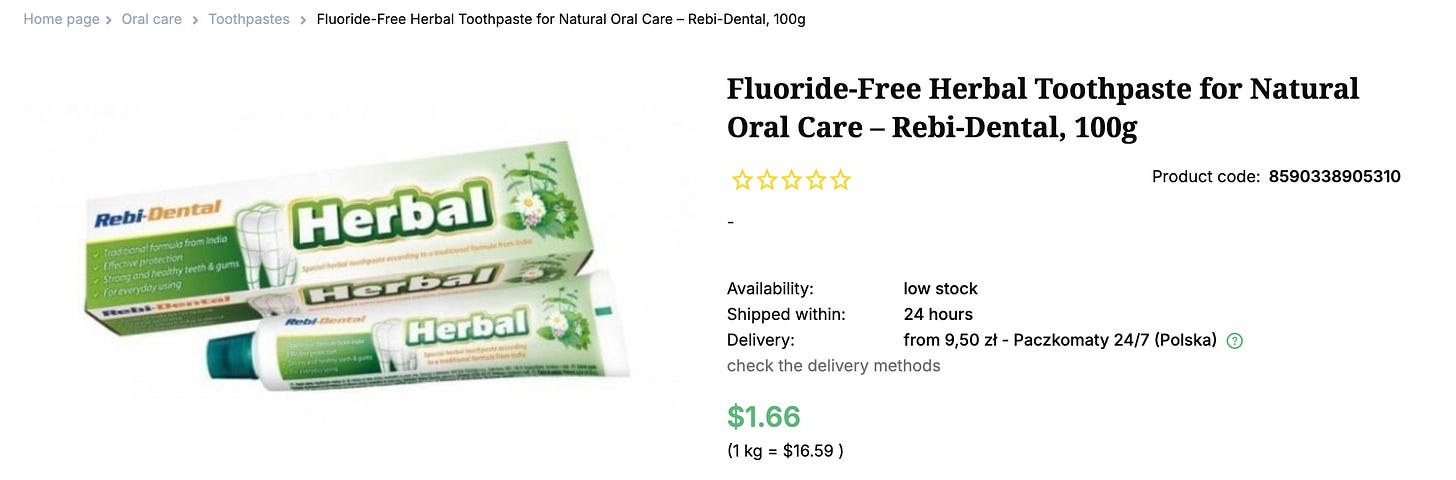
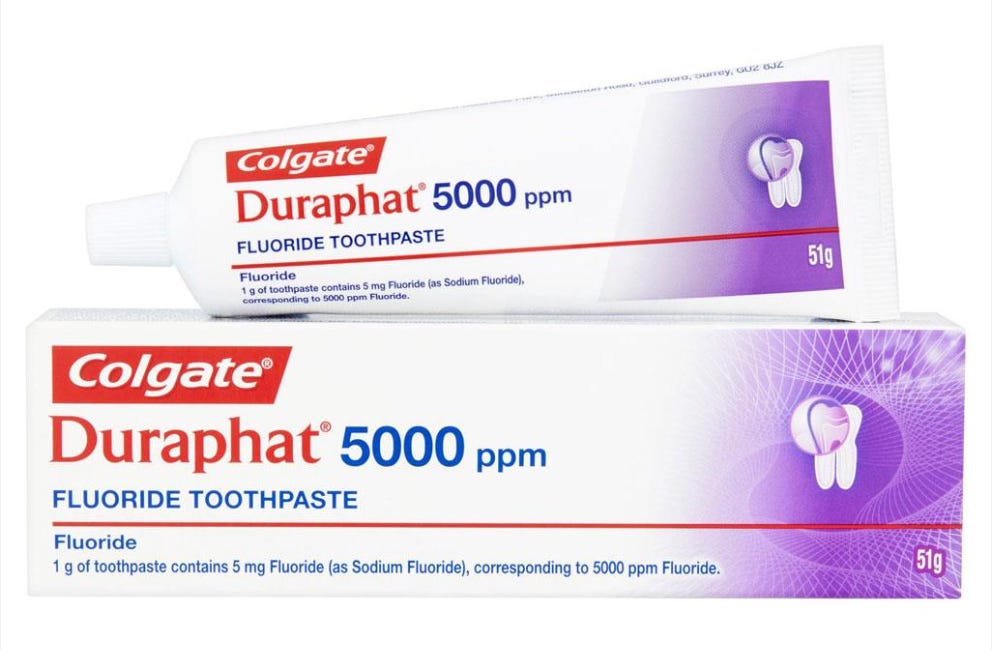
But there’s no real reason to stop at 1450ppm. You can get much stronger toothpastes, up to 5000ppm. If fluoride stops cavities, why should we not have more of it?
The answer is basically safety. There are specific groups who shouldn’t use high-fluoride toothpastes – children and teenagers can get dental fluorosis, which leads to your teeth being permanently discoloured and mottled. And if ingested in large amounts, fluoride can be toxic.
Toothpaste eaters: this is why we can’t have nice things
In several cases, people have presented to the ER with osteofluorosis because they have been eating their fucking toothpaste.
On questioning, we found only one cause for chronic fluoride intoxication: excess and unusual use of toothpaste. The patient brushed her teeth 18 times a day and swallowed the toothpaste, because she liked the taste. She consumed a tube of toothpaste every 2 days, thereby swallowing 68.5 mg of fluoride every day.
But what if you’re neither a juvenile nor addled enough to eat half a tube of toothpaste a day? In that case, it seems like a no-brainer. For adults with decent oral hygiene, 5000ppm paste makes cavities substantially less likely and can remineralise early-stage cavities, making them much less likely to become clinical cavities33. High-fluoride toothpaste: a multicenter randomized controlled trial in adults, Srinivasan 2014. “The application of a high-fluoride containing dentifrice (5000 ppm F) in adults, twice daily, significantly improves the surface hardness of otherwise untreated root caries lesions when compared with the use of regular fluoride containing (1350 ppm F) toothpastes.”44. How to Intervene in the Root Caries Process? Systematic Review and Meta-Analyses, Meyer-Leukel 2019. “Patients using dentifrice containing 5,000 ppm F- [fluoride] … showed significantly higher numbers of RCLs [root caries lesions] being inactivated than patients using dentifrice containing 1,100-1,450 ppm F- at a low risk of bias.”.
Most adults have early demineralisation they can’t see. High-fluoride toothpaste reverses it.
How much better is 5000ppm? Studies in the 1100–2500ppm range found that each additional 500ppm of fluoride reduces cavities by about 6%. If that relationship held all the way up, going from 1450ppm to 5000ppm would mean ~40% fewer cavities. The real number is probably lower, but direct trials of 5000ppm paste against standard paste confirm a meaningful effect.
Annoyingly, these toothpastes are only available on prescription in most places. Spain is an exception; it can be bought online without a prescription. But you won’t find them in your local drugstore.
As far as I can tell, the above risks are the reason – which is surprising, because drugstores contain loads of stuff that are dangerous if given to children or taken in excess (aspirin for example should not be given to under-16s unless prescribed because of the risk of Reye’s syndrome, but it’s widely available over the counter).
I’m convinced, give me the good stuff
These toothpastes are widely available from online pharmacies and most dentists will prescribe it to you if you ask. Duraphat 5000 costs about £12 a tube – more expensive than regular toothpaste, but you only use a tiny blob of it55. It doesn’t foam up very much, so I use a teeny bit of regular toothpaste alongside it to get that foamy feeling.66. This fun article from Adventure Medic suggests it’s good for endurance athletes and trekkers – the low-foam makes it a bit cleaner if you’re brushing in your tent, you only need a tiny bit of it so there’s less to carry (!), and it’s probably good if you’re going on multi-day expeditions and aren’t being super good with your brushing..
Given the expense and pain of going to dentist to get a cavity drilled and filled (and the ongoing maintenance of fillings that fail; they all have a finite lifespan and will eventually need replacing) this seems like a good deal. Brush twice a day and spit afterwards.
Just don’t eat it.
1 comment
How does the increase in fluoride look once you take into account the smaller volume of toothpaste?
Reply on Substack →