The Magnetisers
"Never magnetise before inquisitive persons"
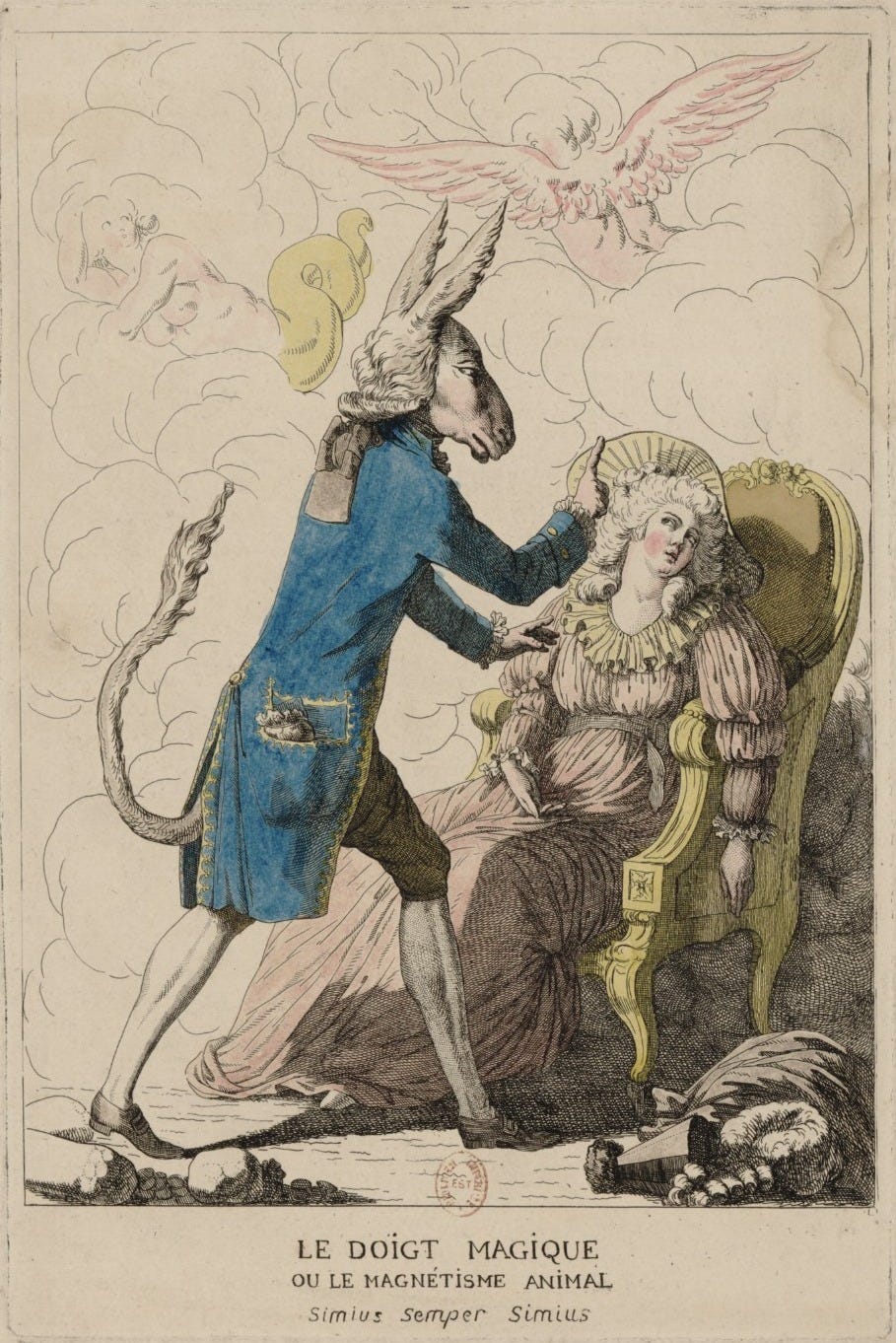
Charles Mackay’s 1852 book Memoirs of Extraordinary Popular Delusions and the Madness of Crowds chronicles a variety of delusions and fads that gripped people of the time. He notes:
Whole communities suddenly fix their minds upon one object, and go mad in its pursuit; that millions of people become simultaneously impressed with one delusion, and run after it, till their attention is caught by some new folly more captivating than the first.
Mackay puts the boot into a variety of charlatans: alchemists, fortune tellers, modern prophets, tulipmaniacs, and monopolists.
Most intriguing of all are the Magnetisers:
[As] alchymy began to fall into some disrepute … a new delusion, based upon this power of imagination, suddenly arose, and found apostles among all the alchymists. Numbers of them, forsaking their old pursuits, made themselves magnetisers. It appeared first in the shape of mineral, and afterwards of animal, magnetism, under which latter name it survives to this day, and numbers its dupes by thousands.
He deftly draws a through line from Paracelsus (who describes a remedy involving magnets being rubbed on the sick patient, then buried with seeds so as to transfer the disease to them), Kircher the Jesuit (who had a hernia patient swallow powdered magnet while wearing an iron filing poultice), Mesmer (whose salons involved water bottles filled with iron filings laid out in a circle, which caused the attendees to flush and convulse), and further nonsense through the 19th century (a magnetised elm tree, magnetised steel pins to cure gout, “never magnetise before inquisitive persons”).
He divides this history into two sections.
The mineral phase starts with Paracelsus travelling through Persia and Asia to find the legendary “mountain of adamant”, selling a magnetic nostrum, and “transplanting” diseases out of the body and into seeded earth:
If a person suffer from disease, either local or general, let the following remedy be tried. Take a magnet, impregnated with mummy, and mixed with rich earth. In this earth sow some seeds that have a congruity or homogeneity with the disease; then let this earth, well sifted and mixed with mummy, be laid in an earthen vessel; and let the seeds committed to it be watered daily with a lotion in which the diseased limb or body has been washed. Thus will the disease be transplanted from the human body to the seeds which are in the earth.
Kircher the Jesuit was likewise a believer in the power of magnetism.
He directed [a man with a hernia] to swallow a small magnet reduced to powder, while he applied at the same time to the external swelling, a poultice made of filings of iron. He expected that by this means the magnet, when it got to the corresponding place inside, would draw in the iron, and with it the tumour; which would thus, he said, be safely and expeditiously reduced.
As word of these miracle cures spread, a sort of ‘inverse magnetism’ appeared, in which any wound inflicted with a metal weapon could be treated with “weapon-salve”, a concoction made from
moss growing on the head of a thief who has been hanged and left in the air; of real mummy; of human blood, still warm … of human suet, two ounces; of linseed oil, turpentine, and Armenian bole[.]
This mixture was to be saved in a narrow urn, and then the weapon which inflicted the wound should be anointed with same salve while the wound was washed with “fair clean water”.
The remedy was brought to England with much fanfare by Robert Fludd, who at 25 went to Europe and became a disciple of Paracelsus’ teachings. On applying the methods he learned abroad he had much success, although Mackay notes this was likely because of his fastidious wound treatment rather than any magnetic sorcery:
[W]hile he kept up the spirits of his patients by boasting of the great efficacy of the salve, he never neglected those common, but much more important remedies, of washing, bandaging, &c. which the experience of all ages had declared sufficient for the purpose.
The magnet craze continued through the 18th century until we reach Father Hell, a Jesuit who strapped steel plates to his patients’ naked bodies to treat various diseases. In 1774 he passed his methods down to Anthony Mesmer.
Thus began the animal phase: with Mesmer and his theory of “animal magnetism” or “mesmerism” as it would come to be known. Mesmerism revolves around Lebensmagnetismus, an invisible magnetic life force found in all living things (including vegetables). He had Father Hell make him some magnetic plates, which he used on patients apparently to great success. Hell tried to claim these successes as his own, with Mesmer mentioned as a footnote. Mesmer was having none of this and accused Hell of breaching his confidence, claiming the invention as his own. The quarrel was the talk of Vienna for some months, with Hell coming out on top.
Nonetheless, Mesmer continued his magnetic crusade. He treated a young woman suffering from a rush of blood to the head and attacks of syncope, using the magnetic plates to great effect, but then discovered he could do away with them and simply use his hands:
When trying the metallic plates of Father Hell, he thought their efficacy depended on their form; but he found afterwards that he could produce the same effects without using them at all, merely by passing his hands downwards towards the feet of the patient, even when at a considerable distance.
His methods were not well-received in Vienna, so he travelled to Switzerland where he had much more success, meeting Father Gassner who similarly could heal the sick by the laying on of hands. He learned the ropes from Gassner, and was able (by his own account) to heal some of the patients Gassner passed to him. He returned to Vienna, still without much fanfare, so moved to Paris, where mesmerism would become very much in fashion.
He ran sessions from his “charmingly furnished” home – stained glass, mirrors, the scent of orange blossom. Mackay describes the events:
In the centre of the saloon was placed an oval vessel ... in which were laid a number of wine-bottles, filled with magnetised water ... covered with an iron cover, pierced through with many holes, and was called the baquet. From each hole issued a long movable rod of iron, which the patients were to apply to such parts of their bodies as were afflicted ... Then came in the assistant magnetisers, generally strong, handsome young men, to pour into the patient from their finger-tips fresh streams of the wondrous fluid ... staring them out of countenance to magnetise them by the eye! ... Gradually the cheeks of the ladies began to glow ... and off they went, one after the other, in convulsive fits ... In the midst of it, the chief actor made his appearance ... Dressed in a long robe of lilac-coloured silk richly embroidered with gold flowers, bearing in his hand a white magnetic rod, and with a look of dignity which would have sat well on an eastern caliph, he marched with solemn strides into the room.
He made quite a stir, and even performed a controlled experiment on twenty-four patients at the Faculty of Medicine, half of whom would be treated magnetically, and the other half treated using the usual methods. But he made conditions on the assessment of the treatment’s effectiveness that were strict enough that the faculty did not agree to them.
Mesmer’s reckoning came even without performing the experiment which would surely have debunked his methods. In 1784, Louis XVI assembled a joint commission of the Faculty of Medicine and the Académie des Sciences – whose members included Benjamin Franklin, Antoine Lavoisier and astronomer Jean-Sylvain Bailly – to investigate the claims. Mesmer did not attend the sittings.
The commission ran experiments to investigate Mesmer’s claims. They magnetised some objects and not others, then asked patients to identify which was which. They also tested the effects of telling patients they had been magnetised while doing no such thing (today we would call this a “sham procedure”). When patients knew they were being magnetised, the effects appeared regardless of whether any magnetic chicanery was actually happening.
The commission eventually published their report, drawn up by Bailly:
After detailing the various experiments made, and their results, they came to the conclusion that the only proof advanced in support of animal magnetism was the effects it produced on the human body—that those effects could be produced without passes or other magnetic manipulations—that all these manipulations and passes and ceremonies never produce any effect at all if employed without the patient’s knowledge; and that therefore imagination did, and animal magnetism did not, account for the phenomena.
With his reputation in tatters, Mesmer left Paris (albeit with 340,000 francs of subscription money) and retired comfortably to Swabia. Nonetheless he spawned a dozen imitators of his methods, who promulgated his beliefs to the modern day. His ideas, debunked as they were, comfortably outlived him.
The 1784 commission had run perhaps the first placebo-controlled trial in medical history to debunk the myth of the Magnetisers. Yet a cottage industry continues to push magnetic chicanery, with “magnotherapy” rings, bracelets, wristbands selling tens of millions of units a year. And for those with furry friends even magnetic dog collars are available – although presumably the owner’s imagination is doing more work than the dog’s.
Thanks to Alec Thompson for pointing me towards this subject.
2 comments
This is good, too: The Martians: The True Story of an Alien Craze that Captured Turn-of-the-Century America
I shall have a read!!
Reply on Substack →