The weirdness of living alone
little boxes made of ticky tacky
Oh, we know, both of us, that it shouldn’t matter, that there’s more to life than pairing off, that the media is to blame, blah blah blah. But it’s hard to see that, sometimes, on a Sunday morning, when you’re maybe ten hours from going down to the pub for a drink and the first conversation of the day.
—High Fidelity, Nick Hornby
Living alone is a rite of passage11. For simplicity this piece only discusses Anglo-Saxon/Northern European cultures, the only kind I have any familiarity with – there are other cultures where living alone isn’t high status/desirable in the same way.. When you’re younger you probably share a house or a flat (or even a room), first at university, then as a young adult who can’t afford anything better. It can be a bit of an annoying experience, what with people not cleaning their dishes, or shirking on chores, or staying up too late being loud, but you put up with it. It might even be fun!
But living with other people is failure-coded past the age of about 30, so when you make a bit more money, you leave all that behind and get your own place. (It’ll likely be much smaller and less nice than what you could’ve afforded if you kept sharing.) The appeal is undeniable: your own space to do with what you wish, subject to the whims of your capricious landlord. No sharing cupboards or a freezer drawer, no messes to deal with, no-one to ask for permission.
(For some this will be a bigger relief than for others. I know someone who shared a room until she moved into her own place – first at home as a kid, then at boarding school in a dorm of sixteen girls, and then her dorm room at university. The apartment she moved into when she graduated was the first time she’d had her own room.)
Assuming your move out of group housing and living alone is a one-way thing, the next time you live with someone is probably when you and your long term partner move in together. Depending how seriously you take dating, this could easily be a few years of living alone. Years where, almost every day, the first person you speak to will be either someone in the office, or a square on Zoom.
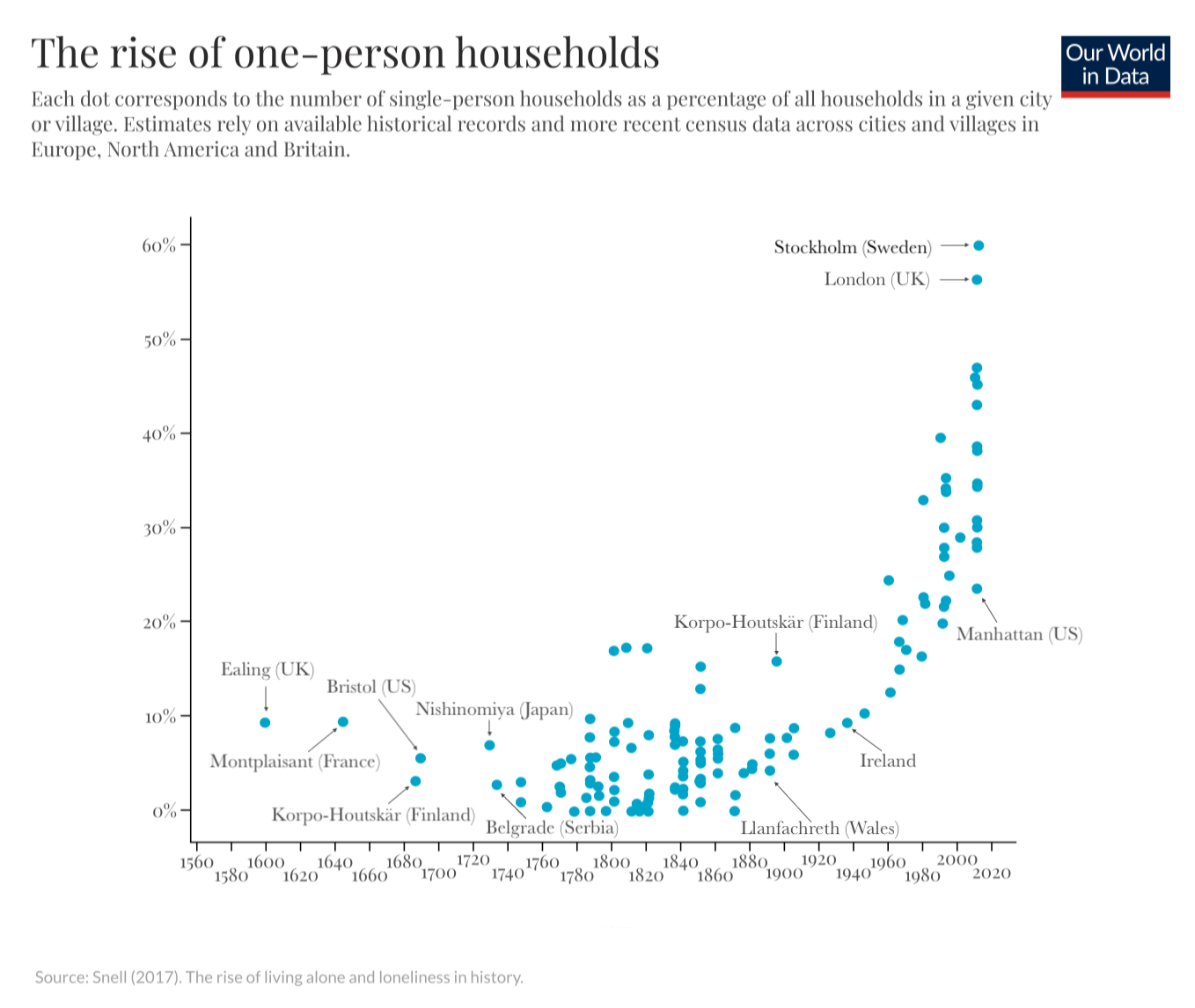
This seems like a profoundly unnatural way to live. It’s also a relatively recent phenomenon: one-person households were 14% of the total in 1961, now 30% in 2022. It’s correlated with higher GDP – the Nordics have much higher rates of solo living. Stockholm is at 60% and London nearly as high. Where people can afford to live alone, they do.
The late Seth Roberts, a Berkeley psychologist and compulsive self-experimenter, did an interesting N=1 study a few years ago on “morning faces”. He noted that if he watched video with life-sized faces in it – he used videos of talking heads, muted morning news, the subject didn’t really matter – he had an improvement in depressive symptoms the next day. His theory was that in our ancestral environment you’d wake and immediately be around other people, and that this acts as a sort of zeitgeber for mood the same way light does for circadian rhythm. This might explain why some people report living with others as highly mood-boosting, and living alone highly dysregulating.
Of course, not everyone finds this to be the case. Many seem quite happy living alone. But I worry that something adaptive happens in that big gap between “move out on your own” and “move in with partner”. You perfect your environment, your own little box. Every year you train yourself for solo living, finding it more and more comfortable – and living with someone else more intolerable. You’re essentially building a habitat optimised for a single animal.
The morning faces thing has an interesting corollary, which is that there are plenty of non-human sources of faces these days. A commenter on a friend’s blog notes that if he spends a whole day away from TV, YouTube, Twitter et al he’s much more likely to start conversations with strangers. You can get as much “morning faces” as your heart desires with a few hours of Netflix.
There are other ways to get your morning faces – you can live with other people! Co-living, group houses, move in with friends. The EA and rationalist worlds seem more into this than others, perhaps because they attract a cluster of high-openness (although perhaps less extroverted) people. There’s a spectrum of Intentionality; some houses are just a bunch of pals living together, some will cook meals for each other, some are full-on intentional community vibes. I love living like this. But it seems clear that, where people have the money to avoid living with others, they broadly choose to do so.
If Roberts is right, then topping up your morning faces with Netflix is like taking a multivitamin to paper over a nutrient deficiency. You might be lacking in something quite important without knowing it because you’ve removed the feedback loop that would have told you so.
1 comment
As someone who has only spoken to one IRL face in one encounter in the past two weeks, I can relate.
Reply on Substack →