I had magnets pointed at my brain
I think it was sometime in January of this year that I realised – decided – I can’t go on like this. Days where I was inconsolable, blinking back tears, drinking in the morning to numb myself. (Partly circumstantial, but not a proportionate response.) That despite the cocktails of drugs I was taking, my depression was ‘not responding adequately to treatment’; that it was ‘treatment resistant’. (Psychiatrists prefer the term ‘difficult to treat’ these days.)
A few weeks later, after a frankly ridiculous amount of medical bullshit, playing phone tag, chasing people around, being kept on hold, I was in the rTMS room. A helmet on the end of an arm was put onto my head and the chin strap cinched down. “If you’re ready, we’ll start the stimulation.”
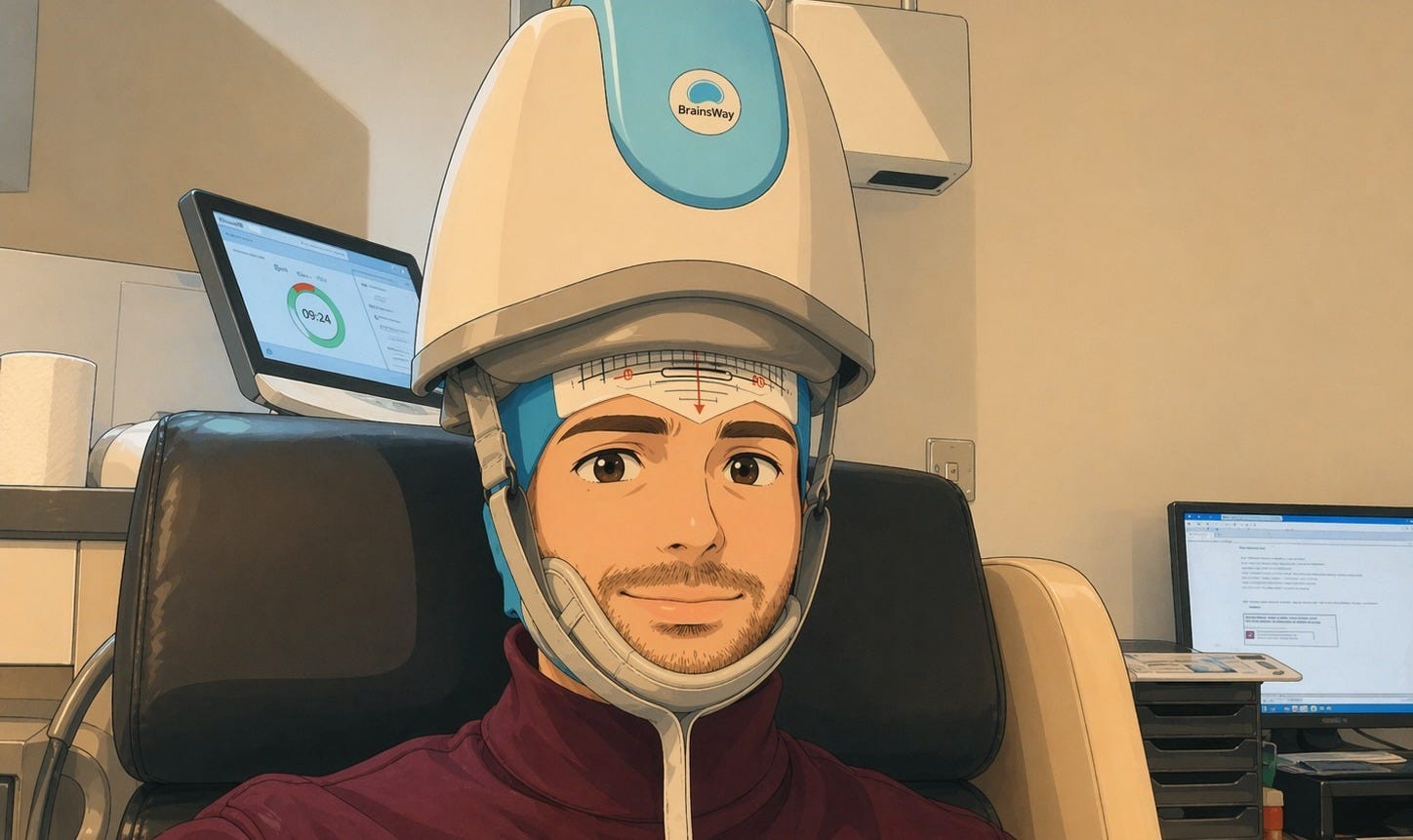
When the session starts, ping – you get delivered 20 short pulses over two seconds, followed by a 20 second break. Ping – another ‘train’ of pulses. You have 55 trains in total, so the session lasts about 20 minutes.
The first time you go in is the calibration session. The technician puts on a cap with a grid on it. She puts the helmet on and uses a foot pedal to apply a single pulse, and watches your ‘motor response’ – basically how strongly your face and hand twitch (on your right side, due to the brain’s cross-wiring). When she’s found the place that gives the largest twitch, that’s marked on the cap and that’s where it’ll be placed in future sessions.
The downside – apart from the enormous cost, thousands of pounds for one course – is that it takes time. The sessions are 20 minutes but you have to go in five days a week for twenty or thirty treatment days (I did twenty).
But as someone who’s taking a career break and is somewhat aimless (how many loss-making side projects can one vibe code really?) it was nice to have the structure. Out of bed, tube to Marylebone, 30 minutes of magnets, and then the rest of the day to write, plan, see friends, see London on a crisp February day.
In rTMS (repetitive transcranial magnetic stimulation), focused magnetic pulses are repeatedly applied to the front-left part of your brain – the dorsolateral prefrontal cortex. This part of the brain is typically under-active in people with depression. The magnetic field induces an electric current in your brain, causing the neurons in a specific area to fire.
Most people haven’t heard of it and are surprised to hear it’s been around for decades – the first TMS device was developed in 1985; the FDA approved the first device for marketing in 2009.
It’s also remarkably effective.
With antidepressants – which I remain enthusiastic about in spite of the prevailing anti-SSRI zeitgeist – the numbers look okay at first (28% remission on your first SSRI). But then the response falls off a cliff – 20% on the second drug, 14% on the third, 10% on the fourth. Side effects which are not trifling, and withdrawal which can mean it takes months to wean off. 40% of people quit their SSRI within three months.
For standard rTMS, 47% of patients show a response, and 22% go into remission. With deep TMS, which uses different magnets to penetrate further into the brain (and which I had, hence the silly helmet), the response rate was 74% and remission 58%.
Medication is a vital part of our psychiatric armamentarium, but sometimes you have to bring out the big guns.
After a week or two, slowly and inconsistently, things started to shift. Things around me were more interesting. I would stop to look at the trees, or the contrails of a plane in the sky. The frantic anxiety waned. I was able to gradually reduce the heroic dose of medication I was on.
Now I’m doing a month-long writing retreat (which I feared would be an emotional nightmare; I checked the price of one-way tickets home before I left), and moving to Berlin for the summer. Things are looking up.
10/10 would recommend.
1 comment
Thank you for sharing. I think it could be useful for many. Good luck.
Reply on Substack →