You can just take less Mounjaro
tl;dr: you can subdivide Mounjaro pens to get less than the stated dose from them. This lets you e.g. buy a 15mg pen and instead get 5mg at a time out of it (so you’d get 12 doses instead of 4). This works out to be much cheaper than buying a pen of the correct dose, and cheaper than using grey market peptides.
[This is not medical advice I am not your doctor etc etc]
(See also: “You’re not sick enough for this medicine.”)
Miracle weight-loss drug Mounjaro comes in fixed-dose pens and a fixed dose escalation schedule. You can 1) choose to ignore this schedule and just stay on a low dose, and 2) subdivide the pens to make them last longer and save a lot of money.
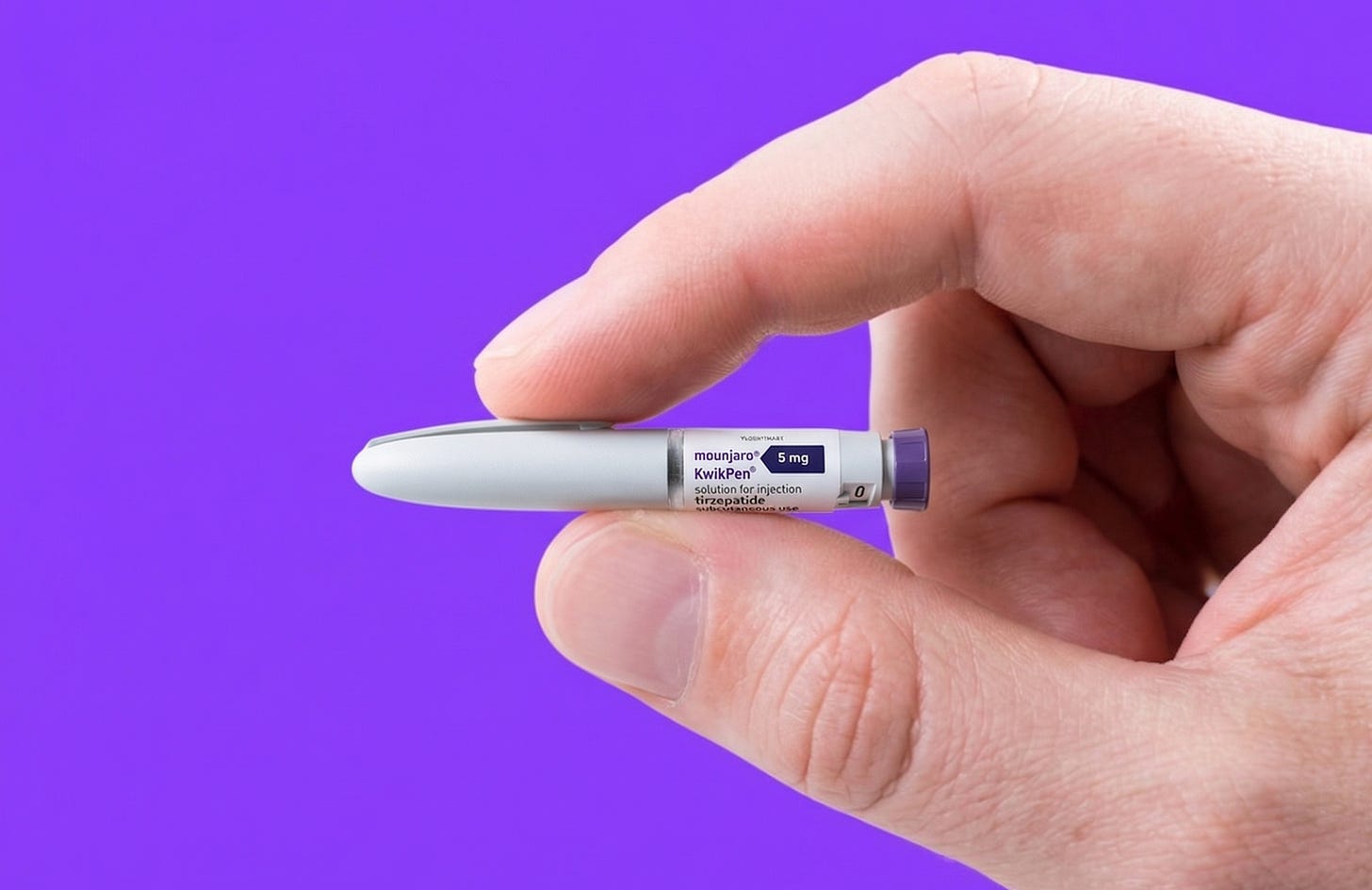
In the US these are often autoinjector pens; there’s no way to customise the dose as it just gives you what’s printed on the side. In other countries you get a KwikPen, which is more like an insulin injector.
You take off the lid, screw on a single-use needle, twist the dial on the end until the window shows “1”, jab yourself with the needle and slowly push down the plunger.
Taking a smaller dose than the pen is designed for means you can stretch them out, and the cost savings are substantial – a 2.5mg pen costs £37.24 per dose, but a 15mg pen is only slightly more expensive. So if you’re using a 15mg pen but only taking 2.5mg at a time, it works out at £12.46 per dose. This is less even than grey market Chinese peptides, which often run $100 for 10mg.
Don’t the pens expire?
Yes, and this is where this trick runs counter to the manufacturer’s advice.
Once you start using the pen, it’s been exposed to the air and to any bacteria on the needle. There is a risk of bacterial growth in the liquid in the pen – the typical guidance is to not use an opened multidose vial beyond 30 days – but this is probably overstated.
The tirzepatide solution in the pen contains benzoyl alcohol which inhibits bacterial growth, although not forever. In the case of e.g. multi-dose insulin vials, using them well beyond 28 days shows negligible contamination in practice – one study found only trace skin flora after 53 days of use, another found the preservatives actively killed deliberately introduced bacteria through day 50, and a third found zero contamination across six months of twice-daily use11. In a study of 69 multi-dose insulin vials used by patients for an average of 53 days, only 8 showed any bacterial contamination at all — just 1 colony-forming unit per millilitre of common skin flora (S. epidermidis and P. acnes), with no endotoxin detected. Critically, when vials were deliberately inoculated with S. aureus and P. aeruginosa and kept at room temperature, they were sterile within 48 hours — and this antibacterial effect was maintained through serial re-contamination at days 17, 30, and 50. A more recent study went further: refrigerated multi-dose insulin vials aspirated twice daily with a new syringe for six months showed no microbial contamination at any point during the study period. A human retrospective study of insulin glargine used up to 74 days beyond the recommended duration found no injection site infections.. Anecdotally people have used the pens for many months after they’re first used without issue.
But the medical guideline is to use the pens for no longer than 30 days after opening. It’s up to you to decide your risk appetite here. Aaron Kaufman wrote an excellent post on how long you can use peptides after reconstitution (which in our case is just after the first time you’ve used the pen):
I’ve concluded that the 28-day limit appears to be conservative regulatory boilerplate mostly divorced from any specific scientific reasoning. … Based on the considerations above, I personally throw out refrigerated reconstituted peptide vials at about the 4-month mark, which is almost totally arbitrary. I make no judgement on what anyone else should do.
The peptide itself is stable in the fridge for many months, up to the expiry date on the pen.
Staying on low doses
The typical dose escalation schedule is to start on 2.5mg weekly for four doses, and then increase stepwise every four weeks up to 15mg. But plenty of users don’t need to go to the higher doses, with many staying at 2.5mg. There’s no good reason to increase your dose if you’re seeing satisfactory results at lower doses.
You can even take 1.25mg, or half the starting dose, if you’re concerned about side-effects when you start.
Guide to getting smaller doses
Counting clicks
To get a smaller dose of medicine, you can “count clicks”. The dial clicks as you rotate it; a full dose is 60 clicks, so 30 clicks gives you half a dose, 15 a quarter, etc.
There’s a trivial and safe way to get around this: use an insulin needle to draw the amount of liquid that you want, and then inject it directly. You can buy the highest-dose pen, which contains four 15mg doses (60mg total) and get e.g. 24 × 2.5mg doses from it. This means you can stretch out a single pen to last many months.
To figure out how many clicks you need for your dose and your pen, you can use this helpful app.
Getting the final dose
The pens actually contain more solution than is required for four doses, I guess to ensure you don’t get an incomplete final dose. You can extract this manually from the pen.
You’ll need an insulin needle and a Mounjaro KwikPen. You can essentially follow any guide to injecting from a multi-dose vial, you’re just using the pen itself as a vial.
Wipe the rubber septum with an alcohol wipe, shown here:
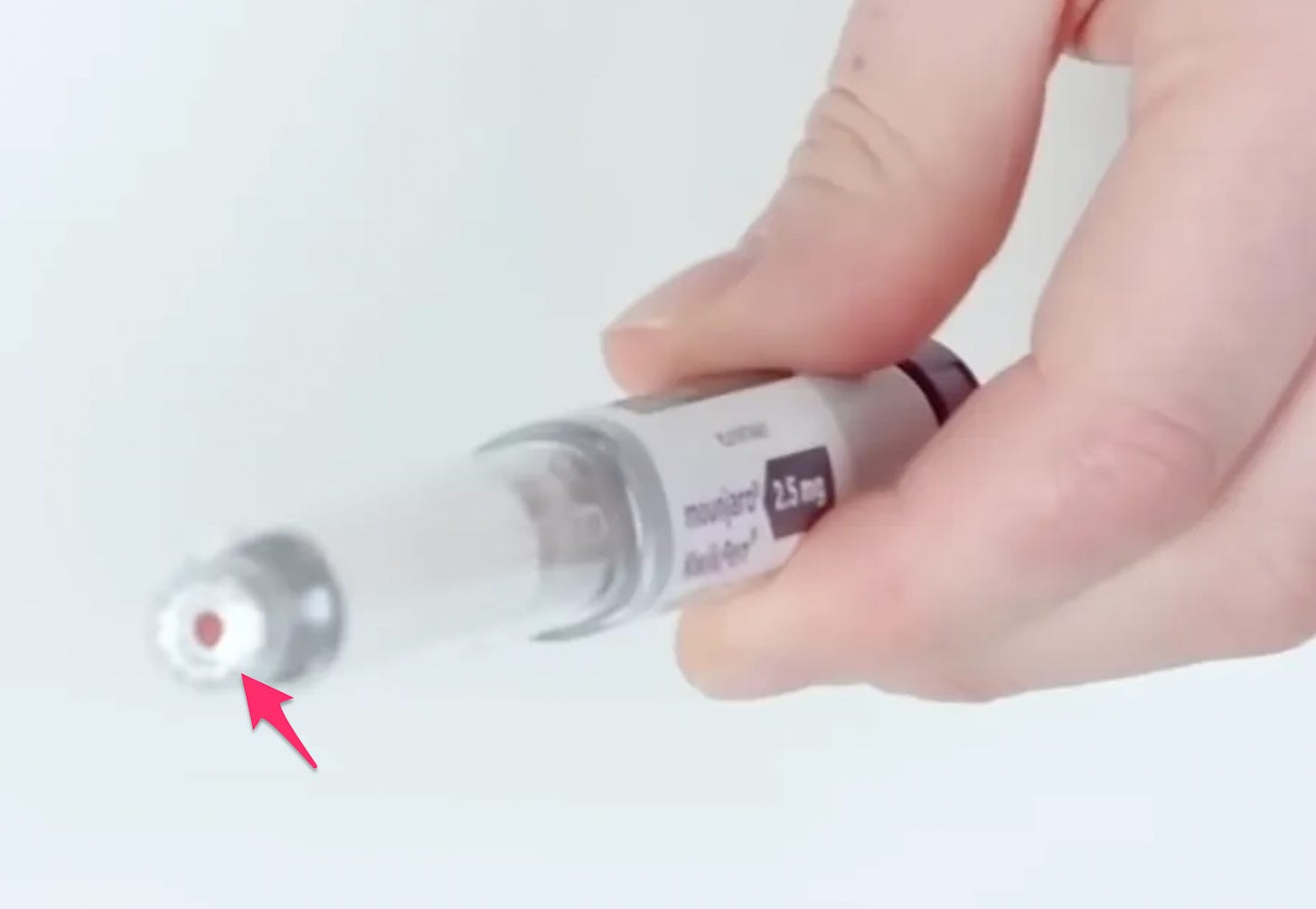
Uncap the needle and insert it through the septum.
Draw up the amount of liquid you want.
Remove the needle from the pen and administer it with correct technique.
3 comments
This was a great post! Thanks for the plug.
> Technically you can “count clicks”. The dial clicks as you rotate it; a full dose is 60 clicks, so 30 clicks gives you half a dose, 15 a quarter, etc. But the pen will only deliver four doses regardless of size and then it locks you out!
Eh??? That has not been my experience at all. My Kwikpen lets me dispense any dose, arbitrarily many times. It eventually locks me out, but only once I hit the total number of clicks in the pen. E.g. the last pen that I finished (nominally 4x15mg = 60mg, 240 clicks total) lasted 257 clicks according to my spreadsheet. When it locked, there was still about a quarter of the serum left in the pen, based on the markings on the side. But I still discarded it because it had lasted me ~4 months, and it was time for a new one.
However, my Kwikpen is from Canada. Maybe the four-dose lockout is a UK thing? Did this actually happen to you, or did someone tell you it happens?
Interesting, looks like I’m totally wrong on this! Dang. Will update this article then - the technique for using an insulin syringe still works to get the extra liquid they add to the pen that’s inaccessible through the usual mechanism so will keep that.
Whatever works for you!
I will say that I like that the disposable needle tips are cheaper than insulin syringes and easier to travel with. Counting the clicks gets you a perfectly measured dose. I do a half-dose every 4 days, instead of trying to last the whole week. The half life of tirzepatide is ~5 days, so by Day 6, things get rough. When I did Inkhaven 1, all the needle tips I would need for my ~6 week visit fit in an empty pill bottle, and I didn't need to try and get more from a California pharmacy without a prescription.
Reply on Substack →