I went on a Zen meditation retreat
I signed up for authentic Chinese Zen (Chan) meditation, but what I got was Osho dance sessions, Argentinian cookbook philosophy, and a former GP teaching Buddhism in the Peak District.
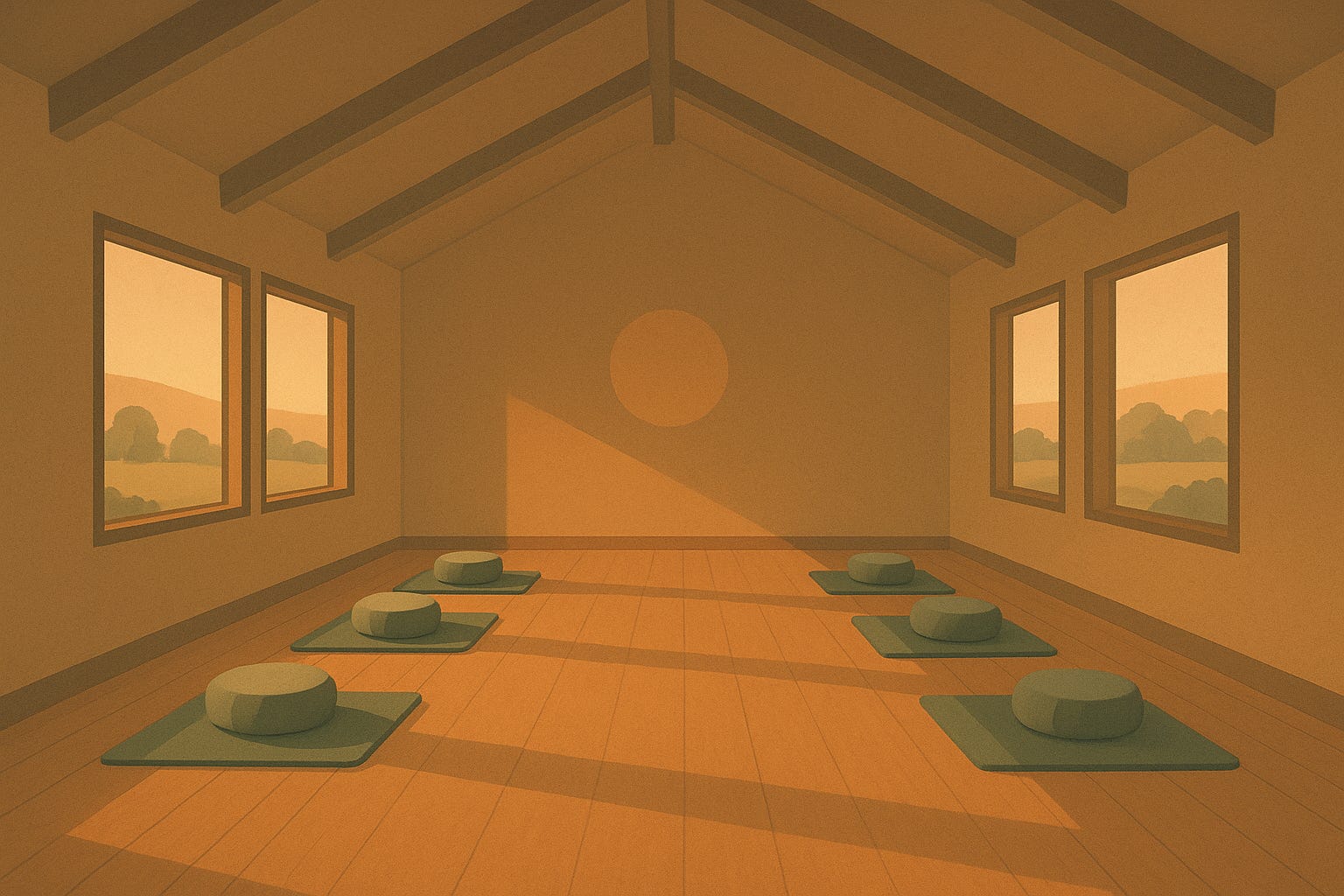
On the first of five nights, after tea, we gathered in the Chan Hall to receive some instruction in how to sit comfortably, and took our vows of silence. Unlike some other schools there’s no obsession with having to sit perfectly still for hours at a time - but comfort is still relative, and I was grateful that there was a drawer full of painkillers. (I definitely wanted to leave on the first day, and even fantasised about just packing my things in the dead of night and driving off. I wanted to give the thing a fair shake though, and I’m glad I did.)
Every day we were woken at 5am by wooden clappers. We had a few minutes to rise, then went outside for morning exercise, led in silence by Simon, our retreat leader. He would give a brief talk, before putting his hands together and saying "tea!"
The days were broadly arranged into three blocks with 30-45 minutes of rest between. The first - exercise, tea, meditate, communication exercise, breakfast, work. The second - mantras, chanting, a morning talk, meditation, communication, lunch, work. And then various meditations in the afternoon, some time to take a walk alone, tea and cake, more meditation, and "action meditation".
-
The schedule rankled me. Every minute of the day was assigned, and in any case there was no time to ourselves outside of the two or three brief rest periods because there was barely enough time to sleep. Something about being told it was "work period" gave me a strong memory of being back in school, which I really did not appreciate.
Work periods saw us doing things like prepping vegetables, cleaning toilets, sweeping floors. When asked if I was handy with a saw I said yes for some reason so was put to work sawing up logs outside. The next day I moved onto sanding and painting a bench. We wore our orange jumpsuits while we worked wordlessly in the sun. Whether it was more Squid Game or Dept of Corrections I couldn't tell.
The bench became something of an obsession. When it rained I felt a pang of sadness that I might run out of time to finish it. I was going to get it painted with Ronseal One-Coat Shed & Fence (Medium Oak) if it killed me.
-
The meditation sits were all half an hour long. I already had a very casual meditation practice, mostly using the Waking Up app and doing what it tells me to do for ten minutes a day (being generous). Waking Up is Sam Harris’ meditation app/course, and it focuses on secular non-dual meditation11. Non-dual meditation focuses on breaking down the perceptual barrier between the self and the rest of the world. The best lay explanation of this I heard is comparing it to the experience of driving a car - quite quickly, you and the car become perceptually fused; it’s an extension of your body. Imagine this extended outwards such that there felt like no clear boundary between you and the rest of the world at all. Spencer Greenberg studied the effects of nondual meditation and the Waking Up app in particular. A surprisingly large number of people using the app learned nondual meditation, and many of those said it was the most important thing they ever learned! which fit well with the style of the retreat.
We were told to keep our eyes open and our gaze soft. Find a fixed point on the floor or wall. Focus on the breath, counting it in and out up to ten and then beginning again at one, or gently covering it with your attention as it comes and goes. As your mind relaxes, things start to appear - at first quotidian things like what’s for lunch or that email you forgot to reply to before you turned your phone off, and then slightly less boring things. A memory of a breakup conversation. Going to a gig with a friend and singing along in the rain. Having dinner with an old housemate.
Why these things? Why are these memories appearing? Often it would be things I hadn’t thought about in years. Sometimes the memories didn’t even feel particularly significant, or strongly valenced. So why was my brain presenting them to me?
I imagined some subprocess of my mind: a nostalgia machine, dredging up things from my past that it wanted me to look at. Their significance (or lack thereof) was up to me to figure out.
I appreciated that part of the practice - that there was no forcing memories out of mind, pushing the mind to be clear. Instead we were encouraged to keep the mind open, allow thoughts in, to be looked at gently, and to be let go.
This ended up being one of the more interesting parts of the retreat, and of my meditation sits since. Sitting and detachedly seeing what arises, what memories the nostalgia machine decides to present.
-
‘Communication sessions’ saw us sit opposite a partner. We would find out their name and question. Questions were assigned at the start of the retreat - this is a huatou or a phrase from a gong'an (koan in Japanese). Mine was "who am I?" Retreatants who had been before might have a question like "what is another?" and "what is life?" which would then be posed back to them ("Henry, tell me who you are"). And you would have five minutes to speak. Your partner would look at you and receive what you had to say, but weren't allowed to smile or speak or nod or otherwise react to what you were telling them.
It was hard to know what to do with this. It felt a bit performative sometimes, like I was tailoring what I said to the person in front of me. We were told not to make callbacks to what the other person said but this was quite difficult - if they start talking about grieving a loved one, it's hard not to want to talk about the same thing!
But over time my answers evolved, even if they felt stilted. I didn’t really feel much closer to being able to say who I was, but against the background of the nostalgia machine it was interesting to reflect on what sort of things kept appearing, being curious about the contents of my mind in a spacious way, without trying to change them.
-
Action meditation was the most unexpected part of the schedule. This was dropped on us as a surprise on the third day, and initially we listened to a half-hour song by Osho where the instructions were to dance like a noodle - on the spot for the first fifteen minutes, and then around the room for the last - before spending fifteen minutes lying down. I have friends who do ecstatic dance and I have some personal familiarity with dancing like a noodle so this came reasonably naturally, but for others it was a challenge.
The following day the action meditation had changed - different music, different timings, but otherwise the same. But on the final day we were on hard mode: now we were given forty minutes of upbeat gamelan and were told to dance as long as we could, but that if we started to fade then we could skip to lying down early. I wasn’t going to accept defeat that easily and ensured we completed our full forty minutes of noodle dancing with maximum gusto.
-
Silence was observed but not super strictly. At dinner you were allowed to ask for things to be passed to you. Retreatants sort of kept to themselves, but didn’t strictly avoid eye contact or acknowledging each other as perhaps was intended. During work periods we talked (as that seemed necessary to co-ordinating and getting any work done). As time went on people were more lax about it, but for the most part we were silent. Simon clarified to me that the intent of the silence was to essentially be solitary, despite being around people - so making eye contact with others was out.
Ultimately a lot of the problems I had early on were to do with how alien it is to be silent. Breaking bread with others is fundamentally a social activity. To sit there in silence with just the sound of crockery scraping seems like an abrogation of your social responsibilities. The same for listening to someone tell their story of their abusive husband, or how something they said to a social worker when they were a kid led to their family being split up, or that their life hasn't been as enjoyable after their spouse died too young - to listen and say nothing feels almost cruel. I attempted to suspend disbelief and figured that everyone was a willing participant. But I found the listening, not the speaking, to be the hardest part.
We were encouraged not to read and write during the retreat and I mostly stuck to this, except for picking up a cookbook from the downstairs bookshelf. I guess these were considered bland enough to be permitted. But one book - Feeding Orchids to the Slugs - was really an autobiography of an Argentinian Zen cook disguised as a cookbook. So I stole it away and would read it under the covers by torchlight when everyone else had gone to sleep.
During interview, I told Simon I wasn't sure how to tease apart sadness from depression. They look and feel similar. But the treatment is different; the suffocating sadness of depression isn't really going to be amenable to introspection. Scurvy makes old wounds open up, but you need to treat the disease, not (just) tend to the wounds. He said that, well, sadness is sadness, and if it goes on for too long then it becomes depression.
That seemed like an unusually reasonable definition for a Chan master. I had expected a more convoluted answer, something about the unavoidableness of suffering. Turns out that Simon, like many of the other teachers, used to be a GP. Depression is long-lasting sadness, sometimes without an obvious cause. No woo required.
This was oddly reassuring. I’ve lived with on-and-off depression for so long that it starts to be like tinnitus - a sort of background noise you start to tune out, at times unbearable and others unnoticeable. It starts to warp your psyche; you think you’re broken, that you’re going mad, that you’ll never be well. And then a kindly gentleman tells you that it’s just that sometimes you’re sad and sometimes you’re depressed and that short-circuits the noise.
-
The food was pretty odd. I had high hopes - Gaia House is meant to have delicious vegetarian food, and they even have their own cookbook. The recipes in Feeding Orchids to the Slugs sounded amazing. It mentioned porridge with stewed fruit for breakfast, and serving meals with gomasio, a mix of toasted sesame seeds and salt flakes lightly ground together. Both of these were present in the meals that were served, so there was obviously some acknowledgement of the British Chan tradition.
The first night was a sort of TVP pasta stew - but the TVP, vegetables and pasta had all been put in a pot and boiled together into soup. The next night was basmati rice and some tofu (no sauce). We had a dal - that was pretty good. And then on our final night a gluten-free pasta bake (accompanied by potatoes and gravy, for some reason). Lunch was always a thin soup and a lettuce, tomato and cucumber salad and vinaigrette. Some days we would essentially eat no protein. I thought that maybe we were on a deliberately bland diet but then we were served fruit and nut flapjacks.
When I went home I stopped at the Watford Gap services and had a McPlant. People looked at me as I laughed with joy eating it.
-
Simon advised us to drive slowly when we left - perhaps only for the first 20 or 30 minutes but it was good advice. I spent too much time stealing glances out of the window at the rolling landscape and stopped to take photos. The M1, far from being a monotonous 90 miles of motorway, was full of interest: all sorts of different cars and driving styles, highly changeable weather from bright sunlight to torrential rain, and even - can you believe it? - a crisp double rainbow.
There wasn't much of an immediate afterglow after the retreat. Things felt very normal after our closing ceremony. Talking to people over tea - interacting with them like human beings and not as a detached observer - was almost jarringly normal. I had expected my social skills to atrophy from six days of not having a conversation.
But the drive home was almost psychedelic, and the days following were filled with an afterglow that was something like warmth, fuzziness, a sense of amazement at things that I could conjure up at will, or at least tune into when I wanted to.
The afterglow didn't last very long. Three, maybe four days before the ordinary world reasserted itself - a sense of being shown a door to a room, walking through it, then finding yourself back in the corridor with no handle on your side. But it’s at least eye-opening to know that such states exist - consciousness where joy hums beneath everything.
But things are still are slower, calmer. I reach for my phone less. I am more "present" in some sense - an ability to sit back, observe my full field of vision. Things seem more interesting. Being on the plane to New York was fun; the plane was a marvel of engineering, the scenes out of the window were truly beautiful. They always were - I’ve never understood people who get on a plane and immediately close their window blind - but it felt easier to drop into that state of beauty-seeing somehow. Even without the full technicolour of those post-retreat days, the basic capacity to stop and notice is always there.
-
In the days following I found myself drinking much less, taking fewer stimulants, generally being a bit more content with my default state. I’m very much a believer in better living through chemistry and meditation is surely not going to cause me to eschew that, but it was interesting to note that my wants seemed to have changed.
I’m also now drawn to meditation, where before I saw it as a chore - I’ve meditated every day since the retreat, often for 30 minutes or more, where previously I’ve gone weeks without carving out ten minutes a day. I’ve been reading Waking Up (the book) which styles itself as a secular guide to meditation, the neurotechnology of Buddhism stripped of the religious stuff (just as a modern book on chemistry would skip over turning lead into gold).
No doubt getting anywhere close to mastery of one’s mind is a journey of a lifetime - but it felt like the retreat gave me a jump start, much more than I was expecting.
2 comments
>When I went home I stopped at the Watford Gap services and had a McPlant. People looked at me as I laughed with joy eating it.
I LOLed at this.
Honestly I thought I was going to cry
Reply on Substack →